HST for beginners: Gonzo journalism defined by its fans. Should it be emulated?
With the decline in popularity of newspapers I believe something should be done to shake up the way news is written. The problem with this is that some (if not a lot) journalists tend to play it safe with their writing for fear their editor will butcher their work. I’m not talking about the usual mundane 100 word articles about a fender-bender in the high street or a local Mayor caught with a mistress. I’m talking about feature articles that require lengthy a investigative or research process.
This is something HST did best, he investigated to the point of becoming part of the story. He got to the juice of the story, hence the beginning of Gonzo journalism. Should it be emulated? I’m reluctant to give a yes or no answer.
Let me put it like this. Like regular people every journalist is his or her own person. They have their own personality, wit and opinions, although some argue opinions have no place in an journalists’ work. (The opinion factor is one of the prominent features in Hunter Thompson’s work.) Most journalists will only share their opinion if it tends to fall into line with popular opinion. Case in point- Marty Beckerman has no qualms about sharing his opinion be it popular or not, which is why a lot of folks consider him to be of the Gonzo journalist ilk. But he is no HST nor would he claim to be.
I would define a Gonzo journalist as an unpretentious writer who writes as he or she feels, or what he or she sees without thoughts of popularity, or fear of the editor’s delete button.
Looking back on this as I write it maybe I should have used the title Hunter S. Thompson: Should his writing style be emulated? The answer to that would be NO. For my money a Gonzo journalist is just a writer being themselves.
Below are the contributers to this topic. To get to their sites just click their names. Many thanks to all concerned for taking the time to share their thoughts and expertize.
Marty.
Marty Beckerman. Author of Dumbocracy: Adventures with the Loony Left, the Rabid Right, and Other American Idiots. Generation S.L.U.T. (sexually liberated urban teens): A Brutal Feel-up Session with Today’s Sex-Crazed Adolescent Populace, and Death to All Cheerleaders: One Adolescent Journalist’s Cheerful Diatribe Against Teenage Plasticity. HST called him “a morbid little bastard.” He has written for Playboy, Discover, Reason, and many more. Click on his name above and get the full whack. You can see my review of his book Dumbocracy here. And buy it here.
William McKeen is the man behind my favorite HST biography, Outlaw Journalist. You can see my review of McKeen’s book and an interview I did with him here. McKeen first met Hunter in the 70s and has written two books about him. He’s one of the folks we can learn something from. You can buy his books here.
David S. Wills. Scholar, editor, writer, and publisher is currently writing a book about Hunter S. Thompson the man and his relation to Duke the fiend (David’s words) to see one of his many sites just click on his name.
Simone Corday. Spent time with Hunter during his time at The Mitchell Brothers O’Farrell Theater. She’ll give a unique perspective on the ins and outs of Gonzo Journalism. Always an interesting read from Simone. You can see my review of her book and interview here. You can buy Simone’s book here.
Peter Richardson. Author of A Bomb in Every Issue: How the Short, Unruly Life of Ramparts Magazine Changed America. He teaches California Culture at San Francisco State University. He also wrote American Prophet: The Life and Work of Carey McWilliams. He is also editorial director at PoliPointPress, which publishes trade books on politics and current affairs. See my Q+A and review of Peter’s book here. You can buy his book here.
Peter W. Knox. Gonzo Beat reporter at Washington College, Peter went to Woody Creek to cover Hunter’s “Blastoff service” for the premier issue of Five magazine . Peter also did his undergraduate thesis on the theme of The American Dream throughout the life and literature of Hunter S. Thompson.
So in no particular order. Enjoy.
“Buying the Ticket” by Simone Corday
Early in the warm, distant October when I started grad school in English, our fledgling pack met, trying to look our hippest. One veteran grad student in his late thirties stood out—he was dressed in nineteenth century working-class looking clothes, loose shirt and vest with a slouchy hat and beard–distinct from a hippie, back to-the-land look that would have blended in more at the time. Cold Mountain comes to mind, although this was long before Charles
Frazier wrote it or it became a Hollywood distortion. When I asked why he was dressed that way, someone explained he was doing his dissertation on the poet Walt Whitman, and to get into the spirit, decided to dress like Whitman. Even in a more hang-loose era, this was eccentric, and his intense focus set him apart, too. Talk about emulating your favorite author. . . . I don’t know how his experiment panned out, but he was clearly committed. Did he get closer to the spirit of Whitman by trying on his style?
But who am I to point a finger? Fast-forward some years later, when Hunter Thompson was honorary night manager at the O’Farrell Theater and I was a stripper, I chose even more outlandish costumes: gorilla, shark, fencer, horse/cowboy, prom queen, the mayor of San Francisco. . . . “Your shows are so different from what she’s doing. From what everyone else is,” Hunter said, glancing at the dancer onstage, posing in a negligee, “Why?”
I digress. We are talking about whether or not a genre of writing, gonzo journalism, should be emulated. In Wayne Ewing’s documentary Breakfast with Hunter, P.J. O’Rourke asks Hunter, “There have been a lot of kids out there for the past 25 years, trying to write like you. It’s always struck me that there are certain artists, Jackson Pollock is an example, that are absolute geniuses that it’s fatal to imitate.” Hunter answers, “Particularly if you imitate the style without the reality.”
Like it or not, we are each stuck in our own skin, with our own limitations and promise, as writers and otherwise. It’s impossible to escape our exposure to books we’ve read and techniques we have absorbed–but it’s a principle tested by time that to create original work it’s crucial to rely on our own experiences and perspective.
I am not a student of journalism, so I’ve been reading The Gang That Wouldn’t Write Straight by Mark Weingarten, that gives a detailed view of how new journalism, and Hunter’s gonzo journalism, developed and were so innovative while the social history of the 60s and 70s evolved. And as I began to read, journalism as a topic expanded, and I came across so many intriguing books and side issues.
Hunter didn’t identify with new journalism: “Wolfe and Talese go back and recreate stories that have already happened, where I like to get right in the middle of whatever I’m writing about—as personally involved as possible.” In sending Tom Wolfe the first part of Fear and Loathing in Las Vegas, Hunter wrote to him, “What I was trying to get at in [this] was the mind warp/photo technique of instant journalism: One draft, written on the spot and basically unrevised, edited, chopped, larded, etc. for publication.” (quoted in William McKeen’s Outlaw Journalist: The Life and Times of Hunter S. Thompson).
The Las Vegas book started in March 1971, with Hunter’s infamous drug-fueled trip with Oscar Acosta to cover the Mint 400 motorcycle race, and a second trip to cover a convention on drug abuse. Much of the writing took place that summer, when Hunter wrote for 12-hour stints at Owl Farm. After Las Vegas became a hit, and Hunter’s gonzo reputation was secured, he rarely did rewriting.
A few years ago, in a long glass case, the San Francisco Public Library exhibited the scroll of the text of Jack Kerouac’s On The Road. The scroll is 120 feet long, but in the case at least twelve readable feet sprawled before me—this roll of taped sheets the writer fed through a typewriter since the story was spilling from his consciousness so fast. When I leaned closer, On the Road was there in its magnificence, plus extra material, some different word choices—this stream of consciousness masterpiece had clearly been through some revision, more than one previous draft.
Kerouac scholar Paul Marion said: “Kerouac cultivated this myth that he was this spontaneous prose man, and that everything that he ever put down was never changed, and that’s not true. He was really a supreme craftsman, and devoted to writing and the writing process. . . . In truth, Kerouac heavily reworked On the Road — first in his head, then in his journals between 1947 and 1949, and then again on his typewriter.” Between 1951 and 1957, Kerouac reshaped as many as six drafts, desperate to get his work published. But when television host Steve Allen asked how long it had taken him to write On the Road, Kerouac answered “Three weeks.” (Quotes from “Jack Kerouac’s Famous Scroll, ‘On the Road’ Again,” by Andrea Shea, on NPR’s “All Things Considered,” July 5, 2007)
Now media and journalism are in flux, with social media and “citizen journalists” playing a part. New technology has added an immediacy and a broadr range of input, while newspapers struggle and diminish. We have moved beyond even the new new journalism, it seems. Now that there are fewer newspapers and fewer journalists employed to report on corruption, it could expand into a cesspool. We need journalists who are skilled at investigation, as well as journalists who master narrative and are developing new techniques. Let us hope they also possess respect for the truth and a sense of ethics. Muckraking can be a masterful tool for social reform, while propaganda can cover up evil-doing, usually by the rich and powerful.
Originality and talent are great gifts, but Hunter had augmented his with hard work, keen instincts, experience—by the time he developed gonzo, he had been a working writer for ten years. “It took me about two years of work to be able to bring the drug experience back and put it on paper. . . . to retain that and to do it right. One of the hardest things I ever had to do in writing. That’s what Vegas is about–about the altered perceptions of the characters. It’s the bedrock of the book,” Hunter explained to P.J. O’Rourke in Breakfast with Hunter.
So, while becoming part of the story can get you to the heart of some substantial material, drugs and liquor in themselves aren’t inspirational. The world doesn’t need would-be Hunters posing with cigarette holders and glasses of Chivas, trying to invoke the gonzo spirit, mimicking Hunter’s exterior style. What is truly needed? Originality; talent; timely, well-chosen material; insight; ethics; and a power of expression in synch with our new time of challenges and unpredictability.
–Copyright 2010 by Simone Corday
Simone Corday is the author of 9 ½ Years Behind the Green Door, A Memoir: A Mitchell Brothers Stripper Remembers Her Lover Artie Mitchell, Hunter S. Thompson, and the Killing That Rocked San Francisco
William McKeen
Gonzo: May it Unrest in Peace
It’s not hard for me to recall my life as a college freshman. When I was a young and impressionable writer, I fell under
the spell of Hunter S. Thompson.
It was the early 1970s and after reading Fear and Loathing in Las Vegas and his presidential campaign coverage in Rolling Stone, I became a committed fan.
I worked for a small daily newspaper in the Midwest then, and we passed around the newsroom a tattered and disintegrating Fear and Loathing paperback and spoke of it as Holy Writ.
I once tried to write like him. I went to Naked City, Indiana, one of the Midwest’s largest nudist colonies, to cover the Mister and Miss Nude America contests.
It was a disturbing and weird day, ripe for the gonzo-journalism treatment, with pantsless grannies and nudist master sergeants weary of the voyeuristic mobs that came to watch strippers strut and body builders romp naked.
But after two long Saturdays struggling with the story, I came to this important conclusion: only one person could write like Hunter S. Thompson. And it wasn’t me.
As I said, I was young (17) and impressionable. I’m glad I figured that out then, rather than wasting a few years of this short life imitating someone else.
Since becoming a teacher, I’ve faced the same problem from the other side of the table. Young people, enamored of Thompson (or Vonnegut or Foster Wallace or Didion . . . fill in the blank) say they want to write like their hero. “You want to write gonzo?” I ask the Thompson fans. “Sure, go right ahead.” When they fail miserably, I tell them, “See, only one person could write like that and he’s dead.” Pause. “But only one person can write like you.”
Hunter S. Thompson may be the best friend a writing teacher can have. He gives us an example of writing with wit, grace and a unique style. And those who try to imitate that style soon learn how much work went into creation of those masterpieces of non-fiction writing. Through trying and failing to write gonzo, students learn how to unmask their own (pardon the redundancy) style.
So don’t write gonzo. Write what you write.
In another context and speaking of another great artist, Johnny Cash once wrote this:
There are those who do not imitate,
Who cannot imitate
But then there are those who emulate
At times, to expand further the light
Of an original glow.
Knowing that to imitate the living
Is mockery
And to imitate the dead
Is robbery
There are those
Who are beings complete unto themselves
Whole, undaunted, — a source
As leaves of grass, as stars
As mountains, alike, alike, alike,
Yet unalike
Each is complete and contained
And as each unalike star shines
Each ray of light is forever gone
To leave way for a new ray
Johnny was writing about Bob Dylan for the liner notes for Nashville Skyline, but these words might just as well have been written about Hunter.
Peter Richardson
Gonzo is usually considered a species of New Journalism, which grafted literary techniques (first-person narration,
dialogue, etc.) onto the usual conventions of magazine reporting. The taxonomy is good as far as it goes, but it masks some important distinctions among practitioners. Joan Didion and Tom Wolfe never visited Planet Gonzo, for example, and though Hunter Thompson would probably appreciate the comparison to Norman Mailer, the labels take us only so far.
What distinguishes Thompson’s writing at its best is the tension between the experiences he describes–savage is a favorite adjective–and the extraordinary control and precision of his prose. Those little sentence-level decisions create devastating and sometimes hilarious effects. When combined with the unique persona Thompson created, through which the world reveals its perverse meaning, this style precludes imitation. Only a fool would try to emulate it for any purpose besides satire.
Which isn’t to say that Thompson has no progeny. The first place to look is Thompson’s old stomping ground, Rolling Stone magazine. Having hired Thompson after the decline of Scanlan’s, which first matched Thompson with illustrator Ralph Steadman, Jann Wenner is now publishing Matt Taibbi, whose work invites comparison with Thompson’s.
Like Thompson, Taibbi is profane, outlandish, scornful, and funny. He covers politics but also writes about sports, and he makes no pretense of objectivity, at least in the now discredited sense of reflexively seeking out an opposing perspective, no matter how absurd. He also has Thompson’s ability to penetrate and dismiss the bullshit that permeates our political discourse. A major difference is that he hasn’t created a literary character called Matt Taibbi, which is probably wise. This should keep him out of Doonesbury, at least for now, and it allows him to focus more on the scandal at hand. His analysis of Goldman Sachs and the health care debate, for example, can’t be dismissed as the ravings of a celebrity provocateur.
Privately, Thompson complained about writing for a magazine preoccupied with what the Jackson Five had for breakfast. Taibbi could probably say the same thing, perhaps substituting the Jonas Brothers. But you have to hand it to him–and Rolling Stone. They’re doing some of the most interesting and hard-hitting political journalism in the country, and the gonzo parallels are irrefutable. If this is emulation, I say bring it on.
David S. Wills
“Gonzo” is an annoying word. I happen to have it tattooed on my left arm as a tribute to everything I consider as its
definition, but that definition varies wildly from person to person. It’s one of those strange words that mean everything and nothing; it even exists in multiple languages, meaning strength, stupidity and drunken courage.
Gonzo Journalism thus logically takes its cue from these meanings. It means something weird and different, and maybe even dangerous. Gonzo Journalism is by some definitions the sum of the parts of its creator, Hunter S. Thompson: integrity, suspicion, talent, madness, intoxication, and much more.
I would argue, however, that Gonzo Journalism is a one man genre. It can be emulated, and it should be emulated, but it will never be repeated. Gonzo Journalism was born with, and died with, Hunter S. Thompson.
The problem is Gonzo Journalism was so unique to Thompson that any piece of writing that incorporates more than one or two its features ends up looking like a parody. Thompson so deftly marked his own literary territory that no writer since has been able to write anything “Gonzo” without looking like a thief.
Marty Beckerman
HST is one of those authors—like Bret Easton Ellis, Stephen King, Dave Barry and Charles Bukowski—whom amateurs cannot resist emulating. (I know because I have emulated all of them.) Fittingly enough Thompson owed much to
Hemingway early in his career, a natural part of the process, but nobody loves Thompson’s writing because “it’s just like Hemingway!” With the Kentucky Derby article and especially Fear and Loathing in Las Vegas, Thompson stopped aspiring to the title of The Next _____ _______ (Faulkner/Fitzgerald/etc.) and instantaneously evolved into The First Hunter Thompson.
People who dream of glory as The Next Hunter Thompson are missing the point, kind of like how right-wingers impose fascism to defend freedom, or how teenage nonconformists all dress exactly the same and slash their wrists with the exact same corporation-manufactured razorblades while listening to the exact same moody songs, those whiny f*****g pussies.
All writers have influences, and you can learn a lot from your heroes. (Thompson evoked Hemingway, Hemingway evoked Twain, Twain evoked Shakespeare, Shakespeare evoked Homer, Homer evoked Ray Charles, etc.) The problem is that readers can tell when you imitate another writer’s voice, even if they have never read the original. They might not know enough to say “this sounds like _____ ______ ,” but they inherently know “this does not sound like you.” When you put 100% of yourself into your work—which requires unique life experiences, most likely unpleasant ones—the readership automatically recognizes the birth of an original voice, and that is why people will love you, not because you copied (excuse me, “gave tribute to”) another guy’s mannerisms and catchphrases and techniques and opinions.
If you covet the crown to the gonzo kingdom, your writing will suffer from an inherent and malignant dishonesty. If you really want to emulate the great writers, then deliver the truth in your own way. The footsteps of giants can lead us to the mountain, but we must reach the pinnacle ourselves. Mahalo.
Peter W. Knox
The photo below by Peter W. Knox. The portraits of eight great writers line the black tent containing HST’s blast-off August 2005 funeral. For more of Peter’s great photos see here.
The son of a librarian, Hunter S. Thompson found himself surrounded by books at a very young age and would keep those influential writers close to him throughout his life, as eventually the portraits of F. Scott Fitzgerald, Samuel
Coleridge, Joseph Conrad, William Faulkner, John Steinbeck, Henry Miller, Mark Twain, and Ernest Hemingway would hang along the entrance of the tent to his incredibly gonzo funeral.
Thompson was fond of saying “He that is taught only by himself has a fool for a master,” and served as living proof. Long before Thompson successfully developed his own (now infamous) style, he would copy The Great Gatsby word for word (among others) to better integrate Fitzgerald’s rhythms into his own (and to experience, he admitted, just how it would feel to write something that great). Thompson was a well-studied scholar and never stopped reading, admiring, and pondering the greats that paved the way for him to join them.
While Thompson certainly labored over the texts of these literary greats, he harbored no delusions of emulating them. He wanted to write, as they had, the Great American Novel and wanted their fame, but not necessarily to take their style. Instead, like any to-become-great writer, Thompson wrote non-stop for years, taking what he appreciated from each and rolled them into his own style, born of necessity, deadlines, chemicals, and yes, fear and loathing. Look hard enough at any of his work and you will see its inherited literary DNA, but pull back and the piece as a whole becomes its own animal, one the likes of Library of Congress had never seen, and some say, never will again.
I stood outside Owl Farm’s security patrolled wooden fences that hot August day and could see just far enough into the large black tent containing the funeral party to see the start of the black and white portraits eager to welcome Thompson to join their ranks in the great library in the sky. As whiskey bottles got passed around the other outcasts, this very debate was taking place. Among a group of such loyal admirers and gonzo enthusiasts, there was not one of us that wasn’t guilty of several cheap attempts to channel the Good Doctor into our own writing, just as every late 90s guitarist cops to playing a few bars of Nirvana when they first started playing, and the ‘Gonzo Beat’ was currently working out for several Thompson fans present, myself included.
If imitation is indeed the highest form of flattery, there was more than enough smoke to blow Thompson’s ass out of the cannon that night, as the bottles were drained and the boasting grew louder to challenge the Japanese drummers counting down the fireworks. But as the opening chords of Dylan’s “Mr. Tambourine Man” began to echo across the Woody Creek valley following the colorful and loud explosions of the blast-off, a quiet reverence, and with that a humble sense of loss and enlightenment, settled in the fields.
The question of whether Thompson’s writing style, ‘Gonzo’ or otherwise, should be reproduced, emulated, copied, or even attempted no longer mattered. He was gone, like the greats before him, and try hard as we might, fan writing won’t come close to replicating that magic. As the ashes mixed with the Aspen dirt, so must those writers influenced by Thompson take from his style what speaks strongest to them and make it their own—tis far better to learn from many masters than just one.
Gonzo Journalism Defined by its Fans: Should it be Emulated?
This is part 2 of our HST For Beginners series. The definite contributers are as follows…
Marty Beckerman. Author of Dumbocracy: Adventures with the Loony Left, the Rabid Right, and Other American Idiots. Generation S.L.U.T. (sexually liberated urban teens): A Brutal Feel-up Session with Today’s Sex-Crazed Adolescent Populace, and Death to All Cheerleaders: One Adolescent Journalist’s Cheerful Diatribe Against Teenage Plasticity. HST called him “a morbid little bastard.” He has written for Playboy, Discover, Reason, and many more. Click on his name above and get the full whack. You can see my review of his book Dumbocracy here.
William McKeen is the man behind my favorite HST biography, Outlaw Journalist. You can see my review of McKeen’s book and an interview I did with him here. McKeen first met Hunter in the 70s and has written two books about him. He’s one of the folks we can learn something from.
David S. Wills. Scholar, editor, writer, and publisher is currently writing a book about Hunter S. Thompson the man and his relation to Duke the fiend (David’s words) to see one of his many sites just click on his name. I’m looking forward to his insights and thoughts.
Simone Corday. Spent time with Hunter during his time at The Mitchell Brothers O’Farrell Theater. She’ll give a unique perspective on the ins and outs of Gonzo Journalism. Always an interesting read from Simone.
Peter Richardson. Author of A Bomb in Every Issue: How the Short, Unruly Life of Ramparts Magazine Changed America. He teaches California Culture at San Francisco State University. He also wrote American Prophet: The Life and Work of Carey McWilliams. He is also editorial director at PoliPointPress, which publishes trade books on politics and current affairs.
Peter W. Knox. Gonzo Beat reporter at Washington College, Peter went to Woody Creek to cover Hunter’s “Blastoff service” for the premier issue of Five magazine . Peter also did his undergraduate thesis on the theme of The American Dream throughout the life and literature of Hunter S. Thompson.
I am waiting to hear from a few more possible contributers, as soon as I get the nod from them I’ll let you know.
Also I’m in the process of putting together a site dedicated to the HST for Beginners series. I figured there is so much content on this site that the series will get buried in a ton of posts. So, after posting the series here I’ll be putting it on the new site too and linking the sites up. More on that later.
I’m hoping to get this sewn up by the end of next week. Until then.
Dramatic reading of Hunter Thompson’s Derby ‘gonzo’ romp set for the Speed
A nice HST fix from Larry Muhammad here, with a great Ralph Steadman photo.
“Hunter S. Thompson & the Vengeance for Screwjack”
Here is a great piece from The Outsiders Almanac including HST and Wayne Ewing.
http://outsidersalmanac.com/blog/2010/02/03/hunter-s-thompson-the-vengeance-for-screwjack/
Dont forget Wayne’s great Vodcast here.
Banned in Texas prisons: books and magazines that many would consider classics
Yes, HST is included in the ban list.
Banned in Texas prisons: books and magazines that many would consider classics
Posted using ShareThis
John Cusack: Fear and Loathing on the Campaign Trail 72
I came across this on Oprah.com (who’d have thought.) It wont be news to most of you that John Cusack was a friend of Dr Thompson. Anyone who has seen Wayne Ewing’s Breakfast with Hunter will have seen Cusack on stage with Hunter at Johnny Depp’s Viper Room. Below are Cusack’s thoughts on Campaign Trail 72. You can see more of his book picks at Oprah.com.
They say Hunter walked the surface of the Earth looking for an honest man and came up wanting. I’d never seen politics approached with this kind of candor or insight or capacity for looking at the
underbelly of it. During the 1972 presidential campaign, he did a series of articles for Rolling Stone that are collected here. His mixture of artistic sensibilities with journalistic excellence, all to find the core of truth—I thought that was pretty incredible. Mostly, I admired the ferocity of Hunter’s mind. I got to know him as a friend in the ’90s. He was still reading everything, processing all this information, and seeing the patterns underneath. People forget—because of his Dr. Gonzo persona, which was so much larger than life—what a wonderful writer, thinker, journalist, and advocate he was for the truth and for the American dream. I think he was mourning its passing. Hunter had reason to be disillusioned, but his insights into people, his savage deconstruction of things, the precision, the honesty, and the courage to admit difficult things about himself, his country, and human nature—talk about influential. He sort of blew your mind.
Beat Scene Magazine
After a few months of numerous computer problems Kevin Ring’s site is back in business. Even with the problems Kevin has been working behind the scenes churning out chap-books and of course Beat Scene Magazine. Head to his site here for updates on what is coming and back issues.
Beatdom Issue 5 Coming January 31st
Beatdom: From the Warped Mind of David Wills.
I remember the birth of Beatdom back in 2007, I was supposed to submit an article about the influence of jazz on the Beat
Generation but injured my back and was non compos mentis due to the pain killers. I was disappointed not to get the chance to be part of issue 1 but David gave me a cool mention anyway.
I have been following Beatdom’s progress since the beginning and as an outsider looking in I can see it morphing into a juggernaut of a brand. The difference with this brand though is the fact that it doesn’t seem to be one feeding from the money trough, but one that feeds on the enthusiasm of the founder David, and that of its subscribers.
The latest issue of Beatdom (#5) is due for release on January 31. You can get all the information here including back issues, where to get them, and all you need to know about Beatdom. Issue 6 looks to be a good one too, it will have a focus on travel in relation to the Beat Generation. Be sure to check the site too for regular updates and news.
Taiwan Pirate copy of 1st Edition Hell’s Angels.
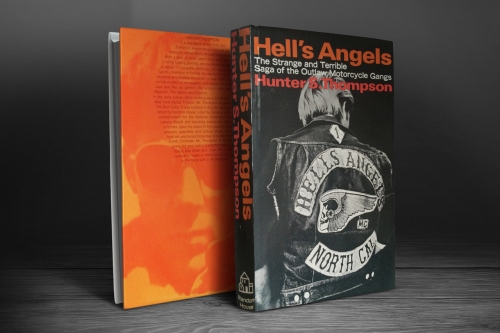
This is an interesting one for any collector of Hunter’s work. I got an email last week from a visitor to the site saying he had a Hell’s Angels book and wanted some information. His description sounded different to any HST book. I had suspicions that it could be a pirate copy so I asked him for some pictures of the book and discovered that he had indeed a Taiwan pirate copy of Hunter’s Hell’s Angels, 1st edition hard cover. The dust jacket looks the same as the real deal , and the copyright page is the same; stating “First Printing” but the similarities end there. Firstly the book is a bit smaller than the original, the pages are very thin with bad quality paper you could almost see through the pages. On the rear leaf there is something written/typed in what I assume to be Taiwanese or Mandarin. There is no motorcycle on the front of the book.
This is a scarce book and not the only pirate copy of Hunter’s books. The other is “The Great Shark Hunt” of Asian origin with similar differences, such as size, quality and Asian text but on the glossary page on this one.
Here are some pictures of this Hell’s Angels gem.. Many thanks to the fellow for the pictures of this (he knows who he is.) He picked it up in a flea market by the way, so you never know what yer going to find. There is one for sale here if anyone is interested, not a bad price at $250.